Showing posts with label Occupational Therapy. Show all posts

Thursday, December 5, 2013

Hippotherapy


Hippotherapy has been on our radar for Emma for a long time.  We first ruled out Atlantoaxial Instability by x-ray when Emma turned two.  As soon as we got the okay from our pediatrician we pressed forward as quickly as possible.  Horses have always been a part of Chad's family and I wanted to continue the tradition with our children.  Grant and Olivia love the horses and enjoy riding them, I want the same for Emmalin.  We were very relieved the day we received the news that riding would be safe for her. 


Understanding the majestic power horses yield may help explain the power of hippotherapy, which “refers to the use of the movement of the horse as a treatment strategy by physical therapists, occupational therapists and speech/language pathologists to address impairments, functional limitations and disabilities in patients with neuromotor and sensory dysfunction,” according to the American Hippotherapy Association (AHA).


The horse's pelvis has a similar three-dimensional movement to the human's pelvis at the walk. The horse's movement is carefully graded at the walk in each treatment for the patient. This movement provides physical and sensory input which is variable, rhythmic and repetitive. The variability of the horse's gait enables the therapist to grade the degree of input to the patient and use this movement in combination with other treatment strategies to achieve desired therapy goals or functional outcomes. In addition, the three-dimensional movement of the horse's pelvis leads to a movement response in the patient's pelvis which is similar to the movement patterns of human walking. A foundation is established to improve neurological function and sensory processing, which can be generalized to a wide range of daily activities and address functional outcomes and therapy goals.
Lori Garone is a physical therapist who also is a board certified clinical specialist in hippotherapy. She explains, "the horse's movement… access[es a patient's] central nervous system… by the repetitive and innate rhythm of the horse's walk."
Garone says that movement creates "new motor, sensory and speech pathways in the brain" that can help a patient reach developmental, motor and speech goals.
Garone works for AHA and is a AHA past board director. She says after being around horses her entire life, their ability to heal has never surprised her.
"Incorporating the horse into human rehabilitation certainly is a more natural way for us to heal ourselves in any variety of ways," she explains.
She emphasizes, "[Hippotherapy] is not riding a horse, nor is it horse therapy or equestrian therapy. It is either physical, occupational or speech therapy, and when a specially trained team of therapist, horse, horse handler and side helper incorporate it into a patient's therapy, goals are reached faster."
Hippotherapy is a treatment strategy that "has been incorporated into patients [Plan of Care] for over 25 years in this country and over 40 years in Germany, Austria and most of Europe," Garone explains. Garone began a private practice on Long Island, New York, in 1990 called Physical Therapy In Motion, which incorporates hippotherapy into patients' treatment.  AHA's website shares testimonials from parents of children who have achieved significant success through treatment with horses. "Hippotherapy is more effective than traditional therapies because horses have a unique ability to motivate children to try new things," explains the parents.
For a parent of a child with Down syndrome, the hint of a promise at progress is compelling enough to pursue hippotherapy even when health insurance provides no coverage.
"I cannot say enough wonderful things about [hippotherapy]," shares Ashley, whose 8-year-old son has Down syndrome and recently began treatment at Horse ”N” Around in Lancaster, South Carolina. "It was expensive for us; insurance did not pay," she says. "But, when we were there, I always had a moment of: 'This is worth it, and I will do whatever it takes!'"
As Ashley watched her son interact with his speech therapist (who is trained specifically in hippotherapy), she marveled at his response on various levels, from following commands to talking to and guiding the horse.
His therapist adapted the treatment plan to his sensory issues, finding a larger and thus stronger horse with a heavier trot. "He didn't do as well with the smaller horses," Ashley explains. "He needed the strong input of the bigger horses."
"He was so at peace there," she shares. "I loved hearing him talk so much, follow directions, smile and just enjoy the whole atmosphere and experience."
To find a physical therapist, occupational therapist or speech/language pathologist who is trained in hippotherapy, visit AHA’s resource page.
We currently use Beyond Boundaries and they are amazing.  Our OT, Lori Tankersly, who has been one of my anchor's over the past couple of years, works with Emma during hippotherapy.  She is assisted by Tyler Stone, who Emma absolutely LOVES, and Kandi Brandon, so sweet and patient.  Below is a video of our experience with hippotherapy.
I also want to recognize Jimmy McMinn who is the Barn Manager at Beyond Boundaries and Beth Stamp who is the Executive Director and owner of Allied Therapy and Consulting Services.


You can read more about Down syndrome and Atlantoaxial Instability at http://www.ndss.org/Resources/Health-Care/Associated-Conditions/Atlantoaxial-Instability-Down-Syndrome/


Beyond Boundaries is located at 2195 Peyton Street in Ward AR.  For more information call 501-941-1522 or visit their website. http://www.beyondboundariesar.org


Sunday, September 15, 2013

Muscle Tone vs Muscle Strength

So What Is The Big Difference?

The Difference Between Muscle Tone and Muscle Strength Explained By Diane E Gagnon, M.Ed., PT (Physiotherapist) Biddeford, Maine

Many people don't understand the difference between muscle tone and muscle strength. True muscle tone is the inherent ability of the muscle to respond to a stretch. For example, if you quickly straighten the flexed elbow of an unsuspecting child with normal tone, the biceps will quickly contract in response (automatic protection against possible injury). When the perceived danger has passed, which the brain figures out really quickly once the stimulus is removed, the muscle then relaxes, and returns to its normal resting state.

The child with high tone or "spasticity" has over-reactive response to the same stimulus. When his arm is stretched, the biceps tightens at an even more rapid rate, and the rate of recovery is much slower, even after the stimulus is removed. Full relaxation is difficult to achieve, so the muscle stays taut for an extended period of time. If another stimulus is added before the muscle has a chance to recover (which happens often during normal movement in the everyday world), the muscle contracts again, becoming tighter. Because this child's muscles never truly rest unless he is asleep, the long term result is tighter, shorter muscles with reduced joint range. This is typically seen in the child with spastic CP.

The child with low tone has muscles that are slow to initiate a muscle contraction, contract very slowly in response to a stimulus, and cannot maintain a contraction for as long as his "normal "peers. Because these low-toned muscles do not fully contract before they again relax (muscle accommodates to the stimulus and so shuts down again), they remain loose and very stretchy, never realizing their full potential of maintaining a muscle contraction over time. These are the "floppy" children who have difficulty maintaining any posture without external support. A child's unique neurological wiring determines whether he will be low, high, or normal toned.

Most people have "Normal Tone". In those who do not, a number of factors are involved. Somewhere deep in the muscle are receptors responsible for detecting changes in muscle length. These receptors then tell the brain there is a stimulus, and the brain tells the muscle to contract in response. There are numerous feedback loops to tell the brain whether the muscle has responded appropriately, needs to contract again, relax or whatever... In addition, there are receptors that tell where each joint is located in relation to all the other body parts that help to determine position in space, etc. A delay in perception, decoding, or transmission anywhere along the neural pathways will result in a change from an optimal response, or "normal" tone.

People often refer to having a "toned" body when they are in "good physical condition" and exercise regularly. Their muscles are taut, and they look lean. An out of shape person is referred to as having "poor tone", with fleshy muscles and an abundance of "fat".  Neurologically these people actually have the same "tone", and the fat person is inherently capable of looking as "toned" as the other (with some allowances made for genetic make-up of course), and just needs to exercise regularly. Fitness experts and health clubs will tell you they are "improving muscle tone", when they are actually reducing the amount of fat to lean body mass ratio.

You can improve your fat to lean body mass ratio, and you can become stronger too. These are under your voluntary control. Muscle tone occurs at an involuntary level. We can effect changes in muscle responses with sensory integration treatment techniques that increase the "alert state of the muscle" by bombarding it with sensory stimuli and improve the brains ability to perceive changes in muscle length, preventing it from accommodating to stimuli.

With ongoing treatment and practice throughout the day, the more "normal" response elicited, the stronger and more efficient even low toned muscles become. "That" is the basis of our classroom program for children with low tone. Sensory bombardment can effect changes in perception that then lead to changes in efficiency along the neural pathways. But it goes way beyond a couple of hours a week in the gym.

© 1999 Diane E. Gagnon, M.Ed., PT Biddeford, Maine 04005, USA


My little Emmalin and a fine example of low tone.  So hard to believe this was comfortable.


Tone by Loren Shlaes-Pediatric Occupational Therapist

As a therapist, I sometimes forget that civilians don't understand all of the professional jargon that my colleagues and I use to communicate with each other. I try, when I write an evaluation of a child, to explain what each thing I assess means, and most important, how it affects the way the child functions. But when I hand over a 12 page report to a parent, I have to remember that not everything is sinking in all at once, and that the information I'm conveying has to be absorbed, bit by bit, as the parent can integrate it.

"Low tone" is something we occupational therapists talk about quite often. But parents complain to me that they have no idea what that means. Sometimes it's quite obvious -- the mother of one of the children that I treat just had a baby, and she called me to tell me that the baby is so weak and floppy that it can't tighten its fist around an index finger placed in its palm. Other times it's not nearly as apparent, and a child can appear to be quite athletic and still be plagued by all kinds of problems associated with low tone.

Tone is the amount of electricity that courses through the muscles and allows them to do the jobs of extending the body against gravity, contract themselves around joints for balance and stability, and work for long periods of time without undue fatigue. An example of someone with plenty of tone is a professional athlete or dancer. I'll never forget the time I met my favorite baseball player, Dennis Eckersley. He practically crackled, he had so much juice and electricity flowing through his body! As far as I know, there is no one definitive reason for low tone.

Some people believe that it is a nutritional issue, and that for some reason the body is not delivering, {perhaps because of dietary issues or metabolic difficulties} or the muscles are not utilizing, the raw materials needed for maintenance and sustained use. The child's muscles don't develop well, and so they tire easily.

An under responsive vestibular system can be a possible reason for low tone. The vestibular nerve is responsible for many things. It tells us, along with our eyes and muscles, where we are in space. It also responds to how much and what kind of movement we get, and communicates directly with the muscles that extend us against gravity and allow us to be upright. It also talks to the part of the brain that is responsible for alertness, attention, and arousal. If the vestibular nerve is not picking up and processing this information correctly, the result will be insufficient muscle tone and chronic low arousal.

Another issue that interferes with the child's ability to function is delays in the maturation of spinal reflexes. When a child is born, its nervous system is immature, unlike a horse's -- a pony can get up and walk shortly after birth. Humans start out instead with nervous systems that respond by increasing or decreasing muscle tone in response to certain stimulation, and then go on to refine themselves through movement and play until voluntary control is established. Then the reflexes disappear. If they don't disappear and are dominating the nervous system, the child will have difficulty working his body against gravity.

If your child tires easily, complains that he doesn't have any energy, can't sit up while he's writing, is a chronic slumper, or has a hard time sitting still or sitting on the floor, chances are his tone is low, even if he appears to be athletic. I've seen plenty of boys who could pitch a ball like Roger Clemens -- but their core strength was so weak that they couldn't do a single sit up or lift their chests and thighs up off the floor when lying on their bellies. Children with low muscle tone have an especially difficult time of it in school, because their bodies don't have the effortless uprightness against gravity that allows them to sit still. If they are struggling to stay upright, they're using the mental and physical energy to sit that they should be applying towards attending to the lesson.

I once went to school to observe a little boy who acted out a lot, especially during circle time, when all the children had to sit cross legged on the floor. The day I saw him, during circle time, he sat with his legs straight in front of him and his hands behind his back on the floor, using his arms to brace himself. He simply was not able to sit in the traditional "criss cross applesauce" position, and needed the additional support from his arms, and wide base from his extended legs, just to stay upright. I saw immediately that he was so uncomfortable sitting this way, and that it was so much effort, that he couldn't sit on the floor and attend to what was going on at the same time. He didn't have enough sophistication in his language to tell anyone what the problem was. His only recourse was to refuse to stay there for very long, and this was viewed as disruptive behavior. I suggested to his teacher that he either be allowed to sit in a chair or that he be assigned a place against the wall so that he could sit with his back supported. He was much happier after that, and he was much more able to attend. Low tone affects many aspects of function, which I will address in future posts.  Meanwhile, if your child has low tone, no amount of yelling at him to sit up straight will help. Try incorporating activities to strengthen the trunk, like sitting on a therapy ball while doing homework or watching TV, doing sit ups and pushups, wheelbarrow walking, wrestling matches, and playing with whistles, bubbles, and blow toys to your child's daily routine. Spinning is good for vestibular activation, if your child likes to spin. Or take your child outside and play tag or ball, or organize a game of statues or red rover with other children in the neighborhood.


So Now What?

Evaluation

Your child’s doctor will run a series of tests to determine the extent of the condition. He may use x-rays and other tests to check muscle and nerve function. He will also assess your child’s balance, coordination, and motor skills. Whenever possible, your child’s underlying medical condition will be treated.

Treatment

Hypotonia may sometimes gradually improve with treatment. A physical therapist might use a sensory stimulation program, which involves facilitating muscle contractions by stretching and tapping the muscles. Physical therapy may help improve fine motor control. Your child will also likely be treated by an occupational therapist. The occupational therapist will also work to improve fine motor control.

Speech Therapy

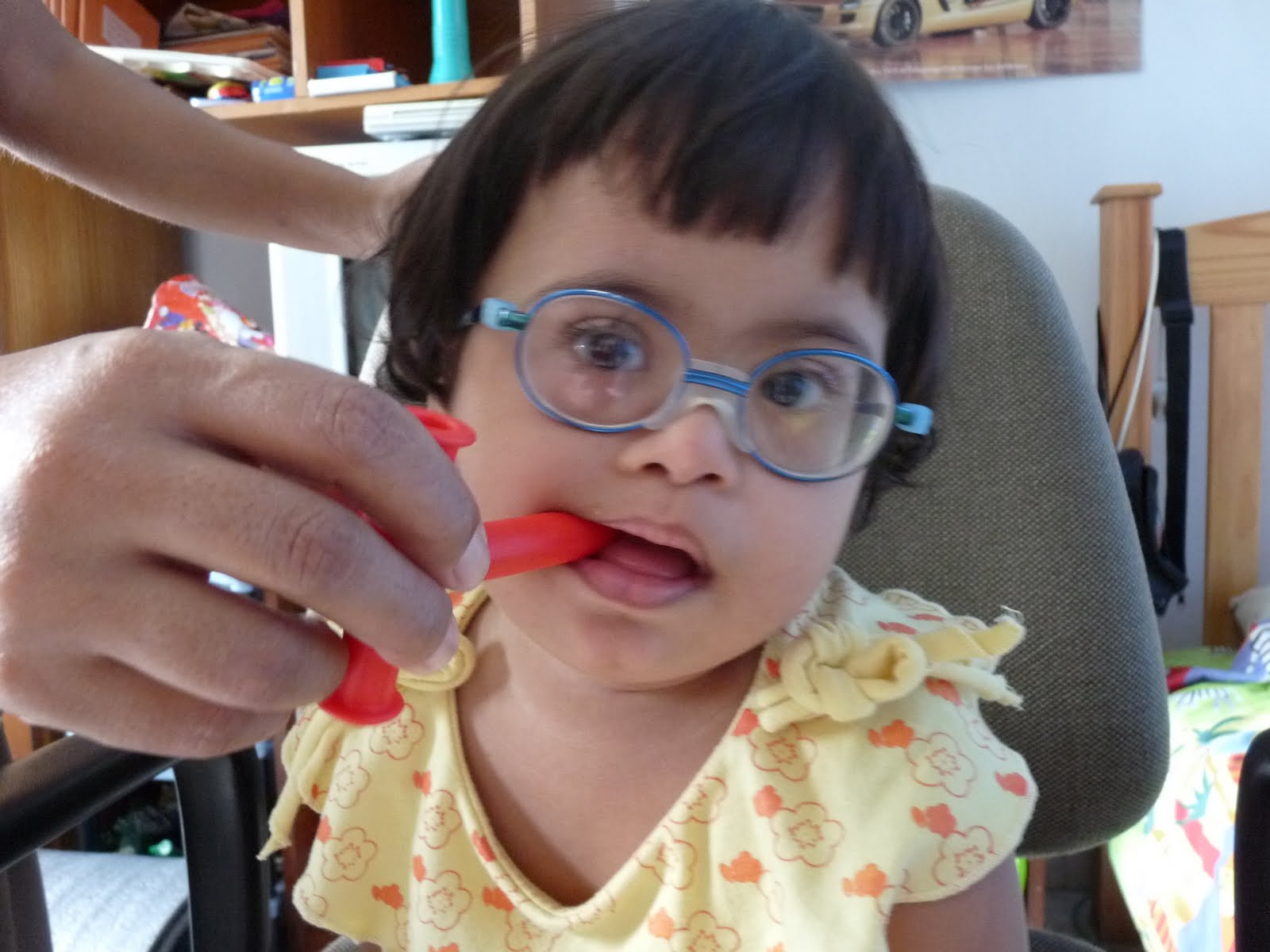
Low tone does not stop with physical and occupational therapy.  Low tone in fact plays are large role with our kids speech.  Children with hypotonia often have trouble breathing and vocalizing. Hypotonia can affect the ability to move oral structures like the jaw, lips, and tongue. It can also affect the quality and rate of speech, often resulting in slurred or slowed speech. A speech-language pathologist (SLP) can help your child improve his swallowing and feeding abilities, as well as address his speech delays. She may help him improve his oral motor skills, which means that he will have better control over his mouth muscles. 

See more at: http://www.speechbuddy.com/blog/language-development-2/coping-with-hypotonia/#sthash.vxUhGShz.dpuf


Emmalin started hippotherapy to help with the low tone.  The horse will be a great addition to our therapy program.


Friday, February 22, 2013

Special Needs Parenting and Working

As a working mother, one question that I get a lot is..."How do you get it all in?".  The answer to that questions is simple.  I have amazing support.  My family and job are amazing.  Emmalin is able to come to work with me which is such a blessing.  I am married to such an amazing man and our other children are incredible.  We have great medical support and even better support from therapist. 

Early on we were on the go a lot because of doctor appointments.  So immediately I knew that Emma's therapy items would have to be mobile.  In 20 months I have perfected what works for us.  Now I can do therapy any time of the day.  Even while waiting for my gas tank to fill up.  Below is a check list of what we try to get in each day.  The program is a combination of what I want to do plus her ND program with NACD.  Now some days we get it all in, some days only half and some days none.  I use to put a lot of pressure on myself to get it all in but quickly realized that if it is a lot for me, imagine how hard it is for Emma.  Also, when you have 7 therapy sessions a week and a 2-3 hour nap each day, work plus travel time, dinner to cook, clothes and dishes to wash and other children that need help with homework and baths, time tends to be a problem.  Our theory...some is better than none.

Now I have blacked out Emma's specific program items.  Her program is designed for her specifically from NACD and us.  I check off the items as I do them.  Some things we do 2-4 times a day.  Some as many as possible and some only once, again all specific to Emma.


Computer for BrillKids programs and IPad for apps.


Oral Motor Therapy


Receptive language


Animals and sounds


Flashcards


Sensory, books and more receptive/expressive language


Everything in one nice neat place.  This bag is the tote from
Thirty-One.
Amazing how much this bag can hold.


Emma at work!  My desk is somewhere in here I promise.


Tuesday, November 27, 2012

NEURODEVELOPMENTAL PROGRAM


This program may be utilized as an adjunct to the traditional therapies.  This is usually an out of pocket expense not covered by insurance.  The closest office to our location in Arkansas is near Dallas, Texas and associated with the National Association of Child Development (NACD).  This program requires a moderate amount of time each day dedicated to your child.  It can be started as an infant or when the child is older.  It gives the parents a daily list of activities to perform with your child that is personally tailored just for him or her. This is a combined program of physical therapy, occupational therapy, developemental therapy, speech therapy, sensory integration, nutritional, therapeutic listening, and more.  I can not say enough great things about how this program has benefitted our children and empowered us as parents to take control and influence our children's future.  It is an investment you won't regret.  There are several programs out there to include NACD, ICAN, and the IAHP. 
NACD: The National Association for Child Development, under the direction of founder Robert J. Doman Jr., has, over its twenty-nine years of existence and work with over 30,000 clients, developed a unique and effective view of and approach to enhancing the development and function of children and adults. Because the fields of education and health care have become more and more compartmentalized in recent years, and treatment approaches are driven more by symptom and label rather than by cause, their methods often fail to serve the uniqueness and totality of the individual. NACD has created an approach to human development, the achievement of human potential, and the remediation of developmental, educational, and neurological problems that is based upon the gestalt of the individual. Our Neurodevelopmental Approach utilizes a neurologically-based, individually targeted, eclectic treatment methodology. The efficacy of NACD's Neurodevelopmental Perspective has been demonstrated with over 30,000 clients—from infant to geriatric—whose function has ranged from comatose to gifted.  Learn more information at http://www.nacd.org/.

Friday, September 21, 2012

Therapeutic Listening Program

                                                                                                             
(Taken from babycenter.com community board “unlimited potential”.  Written by a mother of a child with Down Syndrome, who is also an Occupational therapist.  Interesting information. )
In response to recent threads about using music as a tool to help our children reach their full potential, I thought I would share my experience with a sound based technique called Therapeutic Listening. I am an occupational therapist trained in Advanced Therapeutic Listening, and the mother of a 4 year old girl who has Down syndrome.
Before I describe the "magical" powers of Therapeutic Listening, I want you to think about how music has been powerful in your own life. Does it help you focus? Does it help you dance? Does it make you happy? Does it make you sad? Does it scare the pants off you (think Jaws)?
Therapeutic Listening uses modulated music that has been filtered to enhance elements such as time, space, and detail. Basically, the people who engineer the music are an OT (Sheila Frick) and a musician type (her husband Ron). Sheila tells Ron that she needs a selection that facilitates a specific change, and he makes it happen using the inherent properties in existing music, and then emphasizing (or de-emphasizing) certain qualities that make it even more powerful.
Therapeutic Listening provides direct auditory and vestibular input through specialized and very sensitive headphones and uses the auditory system's connections all over the brain (when you look at a functional MRI of a person who is listening to music, the brain is lit up like a Christmas tree) to affect change at all levels of the nervous system.
Therapeutic Listening is not a stand alone technique. It is important to complete exercises and activities for core and breath activation to achieve the best and most lasting results. I have also found that a reflex integration program done along with Therapeutic Listening seems to have an even more powerful effect. For some clients, specific vestibular exercises are needed as well. For those using Doman (or similar) techniques, you will find a lot of extra activities are probably not necessary.
Together your auditory and vestibular systems are responsible for protection, an understanding of space and time, monitoring and triggering movement, activating core and postural muscles, and they help lay the foundation for vision/oculomotor function. When they are not working well, you may see auditory defensiveness, tactile defensiveness, aimless wandering (inability to "land"), balance/coordination issues, low (or high) arousal, fear of movement, and language/processing delays.
Therapeutic Listening can help with all of the following areas (and more):   Attention,  Visual motor integration,  disorganized behavior, communication, Self-regulation, social skills, Postural Control, oral motor/articulation, Bilateral Coordination, fine motor control, Praxis (Motor Planning-includes speech)
The equipment for Therapeutic Listening is a very good quality pair of headphones and a player (either CD or a specific MP3 with slot radio, depending on whether your therapist has CDs or the newer CHIPs). It costs about $200 and can sometimes be paid for with flex spending funds. You may also be able to get funding from local charitable organizations. Children under two will need to listen to music over speakers, as the headphones may be too much for their tiny ears (according to audiologists). Typically therapists have lending libraries for the music for a small (or sometimes no) fee. Your insurance should cover the therapy visits if your child qualifies for OT or speech therapy already. For my clients, Therapeutic Listening just complements the other techniques I use during my sessions.
A program lasts anywhere from a few months to a little over a year and is very individualized. Music is selected based on a detailed questionnaire and a thorough evaluation and is changed every two weeks with each selection being made after a determination of the progress demonstrated over the previous two week period. The music is tested during a session to see if it is a good fit, and then sent home for the client to listen to for 2, 30 minute sessions each day. Sometimes you will see some regression at first as an individual's brain becomes disorganized before it re-organizes itself in a more efficient way.                                                                                                                                                                                                                                   
It is important to keep your therapist informed of any changes that seem particularly      unusual (or make you uncomfortable).
In order to access this program you will need to find a therapist in your area using this link http://vitallinks.net/pages/Provider-Search.php If a practitioner with advanced training is available, that person would be my first choice as he or she will have access to the entire library of music rather than just the modulated series. If there aren't advanced practitioners in your area, the modulated program (with 24 selections and counting) is still well worth the time and expense. You can always convince your therapist to get the advanced training later on!
I use Therapeutic Listening in my practice with children who have sensory processing disorder, anxiety disorder, autism, ADHD, learning disabilities, and Down syndrome. I have had positive results with everyone including a 10 year old who was suddenly potty trained for bowel movements (with core activation), a boy who has been treated for anxiety with medication for years to no avail who is now having "great" days at school for the first time ever (his words), a child with global apraxia who is using many sentences, a boy who after listening during one session said to me with a smile, "I am unsad!" I replied, "Unsad?" He smiled again, "Yup, and I'm unmad too!"
I also used Therapeutic Listening with my daughter, Carrigain, as soon as she turned 2. She had many signs already, and was a good imitator. She enjoyed pretend play, she knew her body parts, she knew animals and animal sounds. She had a few spoken words and approximations. She did not point, she could crawl but was not motivated to do so, she was never hungry or thirsty, and she was content with whatever was put in front of her. She had some auditory sensitivity, and was especially fearful of the vacuum cleaner (a clear sign of issues with understanding space).
Shortly after starting the program, she started pointing, noticing things that weren't right in front of her, requesting (food, drink, and other things), and crawling faster and with much improved coordination. Her world was starting to make sense and she wanted to explore. Her language exploded. I remember going to an appointment shortly after she turned 2, and her doctor asked how many words she could say. My husband and I were at a loss-we had stopped counting. She was putting two and more words together well before her 3rd birthday. Between 3 and 4, she started using multi-word phrases and sentences regularly. She is now four and her language is not the same as all the other 4 year olds in her preschool class, but tonight she said, "Hey guys, what are you playing with?" Then, "Oh, can I play too?" When she wants something, she says, "Mommy, may I have ______ please?" We have conversations. She makes me laugh. She gives me compliments. She tells her little sister what to do, and helps her feel better when she is sad. She tells me when she is sad, scared, embarrassed, frustrated, etc. using those words.
I was also hoping that Therapeutic Listening would help Carrigain's walking, but she didn't walk until she was almost 3. In hindsight, I think I should have stimulated her vestibular system a little more. Still, when she did start walking, she walked well right away. She tried to do the "Hokey Pokey" the first week she was walking (singing for herself).
I don't know what Carrigain's development would have been like had I not used Therapeutic Listening, but I do know that her language was surprising to most people we encountered in the Down syndrome world. We didn't do any special speech therapy (some early oral motor work and traditional speech). We didn't do an early reading program (although I wish we had). We didn't start Nutrivene, ginkgo, or Longvida Curcumin until after we had finished her Therapeutic Listening program.    Here's what NACD has to say about listening therapy and Down syndrome http://downsyndrome.nacd.org/language_acquisition.php Please note, that they are promoting a different program, but the justification for a listening based intervention is helpful. I am not familiar with their program, but it seems more specific to auditory processing rather than addressing the range of issues that Therapeutic Listening targets.
For a nice video and more information about Therapeutic Listening try this link http://vitallinks.net/pages/About-Therapeutic-Listening.php