Thursday, February 11, 2016

Exercise & DS. How to get moving!

According to the U.S. Centers for Disease Control and Prevention, about 20 percent of all American adolescents and teenagers are obese. Poor dietary choices and a low level of physical activity are major contributing factors to the childhood obesity epidemic in the United States.   Children with Down syndrome have been reported to participate in less physical activity than other children, including children with developmental delays and intellectual disabilities without Down syndrome. This lack of physical activity likely contributes to the higher numbers of overweight and obese children and adults with Down syndrome.  (source)

We all know the benefits of exercise, but these benefits can mean even more for our children with Down syndrome as it encourages muscle strength, better balance, increases endurance, and establishes a foundation for a healthy, active lifestyle. 

As with anyone beginning an exercise program, please discuss with your child's pediatrician before beginning. You should also consider your child's health, interest, limitations, abilities, strengths, weaknesses, balance, and time.  You could also gather input from your child's therapists, such as the physical therapist.   If your child has low energy levels, evaluate their thyroid status, nutritional status, and diet with a professional.

Need help getting started?  Here are some suggestions that work for us.  We usually begin our day with yoga.  If you live in an area with limited internet, you can download the videos from youtube to your computer for free and have access to them anytime.  When you find a video on youtube you enjoy, put "ss" in front of the word youtube in the webpage address box.  If it says "www.youtube.com/star" then you simply change it to "www.ssyoutube.com/star " and hit the download button.  Too easy!


Here are Payton and Presley teaching yoga to their dolls.
They even made their own yoga video.


They also made their own exercise video using a storybook with
 minutes of yoga and 6 minutes of exercises using the fit deck cards. 


Some ideas to get your family moving and make it fun:

          *Cosmic Kids - super fun yoga for all ages.  She dresses up and takes kids on a storybook like adventure each session.  All videos are free on youtube.

          *Yoga Kids - "YogaKids empowers children and teaches them the skills to better care for their bodies, access and interpret feelings, manage stress, solve problems, and connect to others".  Videos for different ages and learning, such as Silly to Calm, ABC's, etc...  I found their videos much cheaper here on Amazon though.


          * Dance X - fun dance moves, but maybe a little fast the little ones.  Here is a clip showing several of the dances.


          *  Debbie Doo and Bounce Patrol - my daughter's favorites to watch.  They encourage lots of movements to fun children's songs.   Favorites Star Jump and Hokey Pokey on youtube.


          * Happy dance by The Learning Station - fun to dance too. Short video with lots of movement to music.


          * Fit cards - the girls get to pull out a card to choose an exercise to do. This could travel easy also.  Costs $7.95.
                         
          * Magic Moves Microphone - the kids push a button and it tells them what move to do, such as "gallop like a horse" or "stomp like a dinosaur".  This encourages good listening too. 

                                          
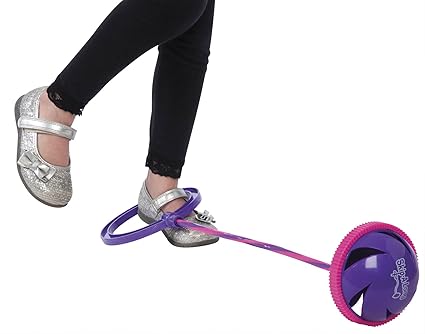
        * Skip A Long - the rope is around one ankle while the other foot jumps over it.  It does require balance and coordination of timing, so better for older kids.


          * Small indoor trampoline - encourage them to jump (if no contraindications for health, such as neck instability, and be cautious with children who stim as this may encourage peripheral vision play).  It is fun to do auditory processing (see previous post)  before each jumping episode.

          * Obstacle course - inside or outside.  We set it up inside using these fun soft play blocks. Here is an example of a fun outdoor one.   We do "follow the leader" and my 4 year old follows my 6 year wherever she goes.  You could also make a small circuit training and have a sign for each even and use a timer to change stations every 30 seconds.  Here is a short clip of ours in our home:
(See previous post here how insurance paid for this equipment)

          * Jump rope

          * Hopscotch - draw it in the dirt or on a sidewalk using chalk or use tape on your floors when indoors

          * Walking - hiking - we call this our "Nature therapy" when we go walking through trails, by the river, or around the farm.  We talk about everything we see.  Sometimes I give them a list of items for a scavenger hunt to make them memorize things.  We stop and write words or math problems in the dirt as we go.


          * Biking - see this article how 30 minutes 3 times a week improved speech, dexterity, and IQ using "assisted cycle therapy".  So strap them into their Smart Trike and get those legs moving as you push the little ones.


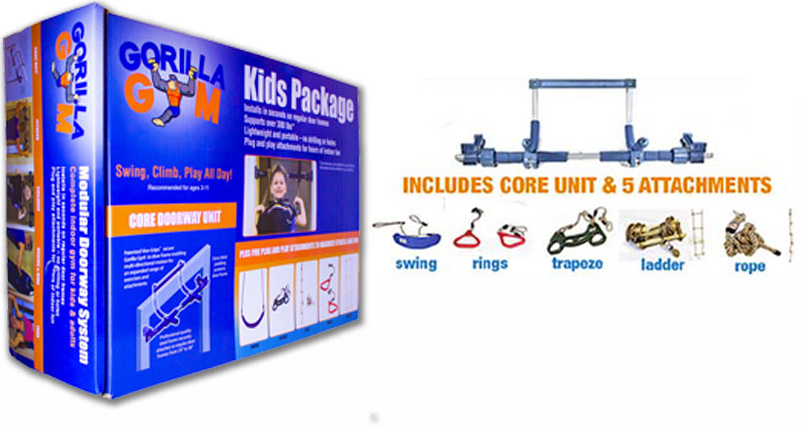
          * Indoor gym - We love the indoor Gorilla Gym they got for Christmas.  It has a trapeze bar, climbing rope, ladder, and regular swing.  You can also attach a platform swing. It attaches to your door frame without making any holes into the frame and can hold up to 300 pounds.  Pretty good indoor play for $150.  See here: 
                               

          * Basketball - we use a heavier cushioned ball indoors to build upper body strength.

         * Balance beams - place a 2x4 piece of wood on the ground or use one like this.

         * Dance class - see Presley 4 year old (DS) doing her routine here. It is always a fun work out for her and socializes her too.  At home, put bubble wrap on the floor and have a loud dance party.

         * Vinyl color dots on the floor.  This creates unlimited possibilities from jumping, auditory processing, colors, counting, or just letting them use their imagination. We found these on Amazon for less than $20.
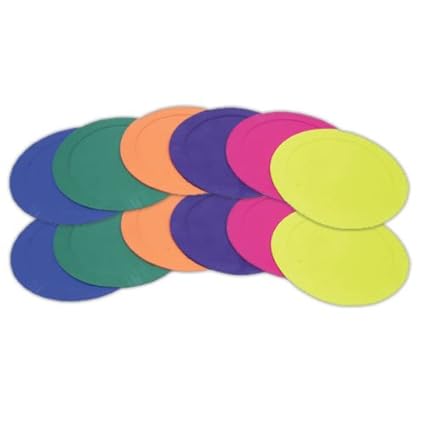
                                      Spots/Markers,9-Inch (One Dozen)

         * Using tape on the floor for kids to follow: (thanks Pinterest)

                  What to Do with Just Some Lines of Tape - 2 very simple tape activities can do quickly - pinned by @PediaStaff – Please Visit  ht.ly/63sNt for all our pediatric therapy pins:      Indoor Gross Motor Sensory Play for Sensory Processing:

               * A fun exercise wheel.

                                        Turn a lazy susan into a fun spinning wheel the kids will love! Label the dry-erase segments with activities, exercises, chores, treats, rew...:


          * ABC exercise cards - click here and print
                                     ABC Exercise Cards - Use at circle time and pick one at rancom to do with students:

         * Make fun exercise dice by clicking here.

                                             Get the Kids Moving Game from Paperelli for iheartnaptime.com:

        *  Cute idea called "exercise eggs" that uses eggs with notes inside there were hidden around the room.
                                             This would make a GREAT brain break idea. What a fun way to use plastic Easter eggs.:

                                                  
         * Others  bowling, soccer or kicking a ball back and forth, climbing, croquet,  hula hoops, Frisbee, tag, swimming, go to a park, skipping, gardening,


I hope this post encourages you and your family to get moving and have fun together.

Blessings,
Robin Tolliver

Monday, February 8, 2016

Righty Tighty, Lefty Loosey


Size grading with bolts, washers, and nuts !!

Hex cap screws and the nuts and washers that fit them are found at most home improvement stores.  I found a combination of these at Home Depot for less than $10.00.  My original sizes were:

3/4" x 3"
5/8" x 2 1/2" 
1/2" x 2 1/4"
7/16" x 2"
3/8" x 1 3/4"
5/16" x 1 1/2"
1/4" x 1 1/4"
1/4" x 1"
1/4" x 3/4" and
1/4" x 1/2"

But after much searching and running out of snacks for Olivia and Emma I put a group together based on longest to shortest with as much variety that I could formulate.  Below is what it looked like.  I purchased two sets, one for each little darling.


Your child can do lots of cool things with the washer and nuts in addition to attaching them.


We started by inserting them into floral blocks based on tallest to shortest.


From there we added the washers...this got a little tricky when they realized the larger ones fit on all or most of them.  So I had them line them up based on size again. 


Made things a little easier.


From there we screwed on the bolts.  Emma certainly surprised me on this one...she did great and was very patient.


From there we pulled them out and rearranged them in different orders.  Talked about tallest, shortest, heaviest, lightest, left, right and middle.


All these objects naturally provide lots of chances to count, and my kiddos love to count.  When counting we make sure we touch and count in synch.  This 1:1 association is very important for math skills development and understanding.

You can introduce all kinds of new words while your child is using these materials.  Examples include:  Largest, smallest, larger than, smaller than, shortest, longest, wide, thin, round, straight, edge, corner, point, side, face, cube, rod, circle, heaviest, lightest, hexagonal and rectangular prism (as Olivia loves to correct me on).

As always...have fun and be creative.


Monday, February 1, 2016

Show Them What "It" Looks Like


Teaching Emma has certainly made my creative side come out.  As we move into math I have quickly realized that teaching her 1+1=2 is not going to be enough.  Memorizing math facts is the easy part, understanding what 1 and 2 really look like will require a different approach.   Emma needs to understand the following:


ONE

1 and


are all the same.


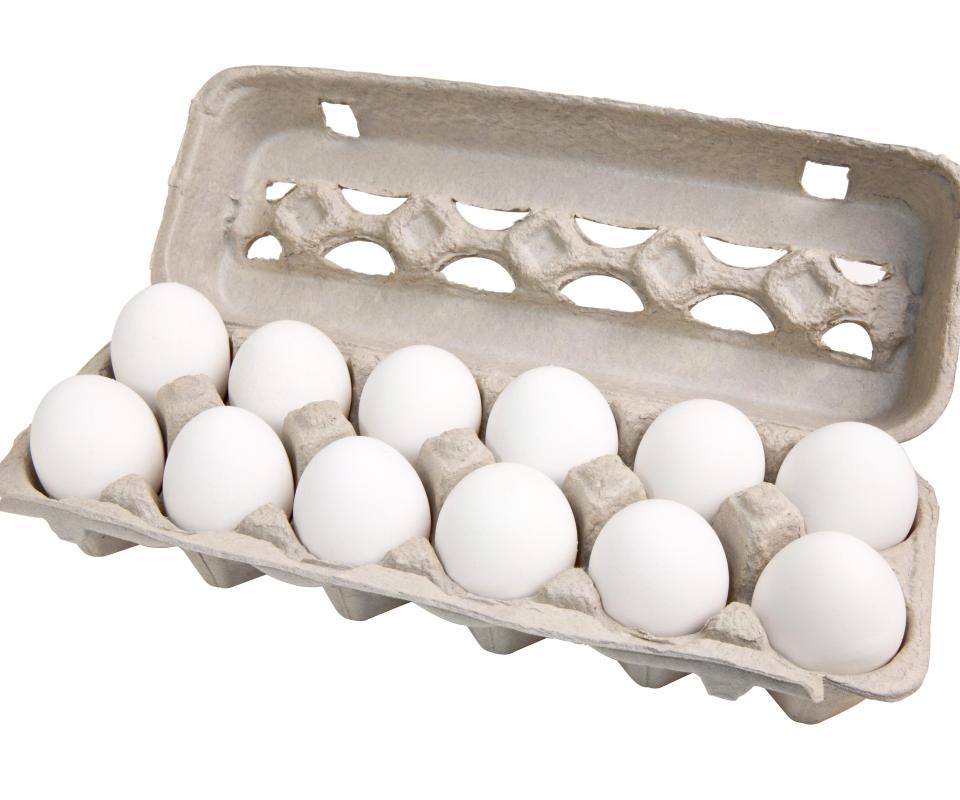
A dozen eggs looks like this


And when we have family game night I want her to see 11 instead of 3 dice.


But like a lot of our kids, you better make it fun.  Emma will hit the road on you if she smells work.  For us, the answer for some time has been Task Boxes.  They are super easy to make, you can get extremely creative and they store very nicely.  Task boxes are single, organized activities with a clear beginning and end.  All task materials are contained within clearly defined boundaries-trays, boxes, baskets, tubs, folders or binders.  Each task is presented with visual organization and clarity.  The materials clearly define the activity and help complete the task.  Task boxes emphasize visual learning styles, avoiding the need for auditory processing of verbal directions, an area of deficit for many of our kids.  Emma has really started fighting me on auditory learning (which has always been her strongest area) so I am cutting her a bit of a break and mixing it up a little.

We started with 0-8 sorting which was a great success.  We will slowly move up the ladder.  Maybe combining two for her to add or subtract.


From there we moved to Under, Over, Left and Right.


I picked up the little pink containers at the dollar store, 4 for $1.  The cards are index cards cut in half with cheap stickers stuck on them and laminated.

You can pick up a very inexpensive laminating machine here.  We have had this one for over 2 years and I have certainly put it to the test and it is still holding up great.

Here is the best bang for your buck I have seen on laminating sheets and laminating pouches.

When the fun is over they fit nicely in these little containers from Wal-Mart.


Shoe boxes are just as effective.  Get creative and have fun.


Saturday, December 26, 2015

Removing MSG could help your family. Here is why.


As the new year is approaching, many people will re-evaluate their diets.  Many moms will re-evaluate their children's diets.  Could it be more healthy or more nutritionally valuable?   I have read many times that what you eat either helps you or hurts you.  I wanted to share some important information for you to ponder over that could positively affect your family and your children, especially if they have the diagnosis DS, ADHD, Autism, anxiety, depression, or have unusual repetitive behaviors.   
 
Glutamate initially came to my attention when we obtained urinary neurotransmitters on Presley when she was 2 years old.    She had noted elevations.
 
MSG is basically everywhere.   In this informative article, Dr Mercola says "MSG is one of the worst food additives on the market and is used in canned soups, crackers, meats, salad dressings, frozen dinners and much more.  It's found in your local supermarket and restaurants, in your child's school cafeteria and, amazingly, even in baby food and infant formula.  MSG is more than just a seasoning like salt and pepper, it actually enhances the flavor of foods, making processed meats and frozen dinners taste fresher and smell better, salad dressings more tasty, and canned foods less tinny."
 
Here  is a video of Dr  Peirson discussing glutamate at the AutismOne conference. (I am having internet issues and can not access it currently or I would comment more about it, will try to update later).
 
The Mayo Clinic says: The Food and Drug Administration (FDA) has classified MSG as a food ingredient that's "generally recognized as safe," but its use remains controversial. For this reason, when MSG is added to food, the FDA requires that it be listed on the label.   Keep reading to see what names they use to hide it though.


This video sparked my interest in MSG again.  I highly recommend you listen to this 16 minute video. This is Dr Katy Reid from Unblind MyMind,  She is a biochemist and a mom of five children.  Her youngest daughter has autism and through dietary interventions/removing MSG, she was able to resolve all her symptoms of autism.  She mentions the connection of gluten/casein/MSG and why some children improve removing gluten or casein, stating reducing gluten and casein also reduces the free glutamate load as well.  Here I read that wheat, barley, oats, and dairy have the highest contents of glutamate. Foods that have lower amounts are fruits, vegetables, potatoes, eggs and tree nuts like pecans, walnuts, and macadamias

She also states: while glutamate, a naturally occurring amino acid, is produced by our bodies and found in many protein-rich foods, including, meat, vegetables, dairy, eggs, fish and poultry, MSG is derived from the synthetic processing of glutamate and found in nearly 95% of processed foods. In 1908, MSG was developed by a Japanese man for the purpose of enhancing flavor in food. He later went on to form Ajinomoto, the world's leading MSG producer and, ironically, also a drug company.

MSG is approximately 78 percent free glutamic acid, 21 percent sodium, and up to 1 percent contaminants.  MSG is an excitotoxin, which means it can overexcite your cells to the point of damage or death, causing brain damage to varying degrees -- and potentially even triggering or worsening learning disabilities, Alzheimer's disease, Parkinson's disease, Lou Gehrig's disease and more. (source).  Per Dr Reid, this free glutamate from MSG is a single amino acid, not linked to other amino acids.  It can immediately enter the blood rapidly and cause surges of varying levels and a variety of symptoms.  Dr Reid says bound glutamate is linked by amino acids to make a series of amino acids and through digestion, there is a slow, controlled release into the blood according to what the body needs. MSG/free glutamate is made when bound glutamate is released from its bond to other amino acids or it can also be chemically created.   It takes a half hour or less for MSG/free glutamate to reach the brain but it takes 4-6 hours for “bound glutamate in food” to get there (source).

Our bodies require glutamate for learning and developmental processes. The amino acids in glutamate are the building blocks of proteins, and subsequently responsible for metabolism and brain function.  Glutamate is also responsible for transmitting signals between neurons and other cells.  We have glutamate receptors all over body, especially the brain, central nervous system, and spinal cord.  When excessive free glutamate/MSG is consumed, it will quickly stimulate this receptors potentially causing a multitude of symptoms within the nervous system and brain.  Receptors are also located in the pancreas and this overstimulation causes excessive insulin release, lowering blood glucose (sugar), thus stimulating your appetite.  Think of eating Chinese food, which is notorious for using MSG, and you can't understand why you are hungry again not long after eating.  There is also 10,000 times the amount of glutamate inside the cells than outside the cells.   It has to be kept in balance, because if glutamate gets outside the cells, it can turn into a toxin an kill neurons.   It can also overly excite the cell, causing it to open its pores excessively and let in large quantities of substances that are normally allowed to enter only in limited amounts (source).

Here is a good video explaining MSG on a simple level and it's effects on different systems of the body.  She also states MSG could be added to dirt and it would make it taste good, which is why it is added to processed foods so they have some type of flavor.  She also states that MSG is given to lab rats to cause obesity and diabetes to do testing of diabetic medications on them.  So why wouldn't it do the same in humans?  There are many opinions and articles stating yes and no.


MSG can be hidden under numerous names.  Per Dr Mercola:
 
These foods ALWAYS contain MSG 
 
Autolyzed YeastCalcium Caseinate Gelatin
 
Glutamate Glutamic Acid Hydrolyzed Protein
 
Monopotassium Glutamate Monosodium Glutamate  Sodium Caseinate
 
Textured Protein Yeast Extract Yeast Food
 
Yeast Nutrient


These foods OFTEN contain or create MSG during processing:

Flavors and FlavoringsSeasonings Natural Flavors and Flavorings Natural Pork FlavoringNatural Beef Flavoring
 
Natural Chicken FlavoringSoy Sauce Soy Protein Isolate Soy Protein Bouillon
Stock Broth Malt Extract Malt Flavoring
 
Barley Malt
Anything Enzyme ModifiedCarrageenan Maltodextrin Pectin Enzymes
Protease Corn Starch Citric Acid Powdered Milk Anything Protein Fortified
Anything Ultra-Pasteurized


Here is a comprehensive article listing restaurants and foods by brand that contain MSG.  We like Chick Fil A, so I also looked on their website to see the ingredients and it does show MSG in the form of yeast extract and maltodextrin.  I did find this good homemade recipe for their chicken sandwich though. So, you can possibly look up your favorite restaurants to see if they list their ingredients.

I hope this information peaks your interest on this topic.  There is an abundance of information about MSG available, some quite controversial, so please do your own research and decide what is best for your family.  As for our family, we will try our best to avoid MSG by eating more real foods and avoiding processed foods.  Processed foods are convenient foods, and moms of children with special needs sometimes need convenience just to survive the day, so make changes slowly and keep moving forward.  Best healthy wishes in 2016.

Blessings,
Robin T.